
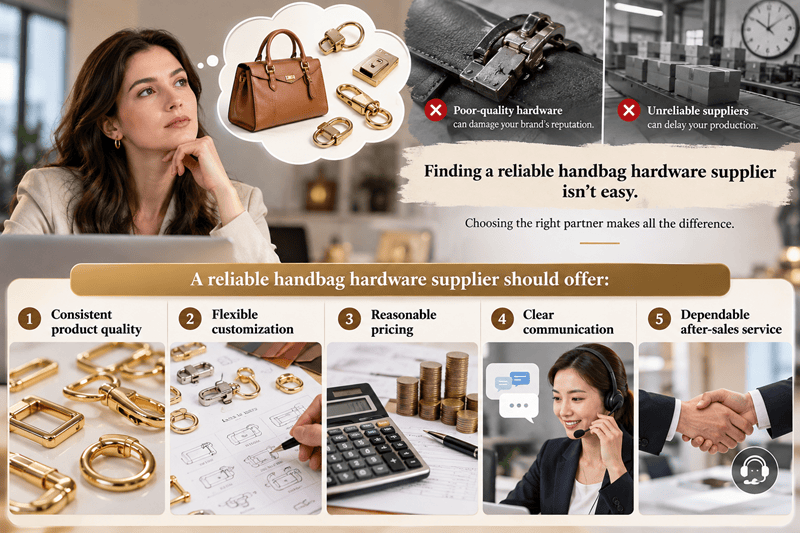
Finding a reliable handbag hardware supplier isn't easy. Poor-quality hardware can damage your brand's reputation, while unreliable suppliers can delay your production. Choosing the right partner makes all the difference.
A reliable handbag hardware supplier should offer consistent product quality, flexible customization, reasonable pricing, clear communication, and dependable after-sales service.
In this guide, I'll share practical tips on evaluating hardware quality, checking customization capabilities, and deciding whether a manufacturer or a one-stop supplier is better for your brand.
How Can You Evaluate Handbag Hardware Quality?
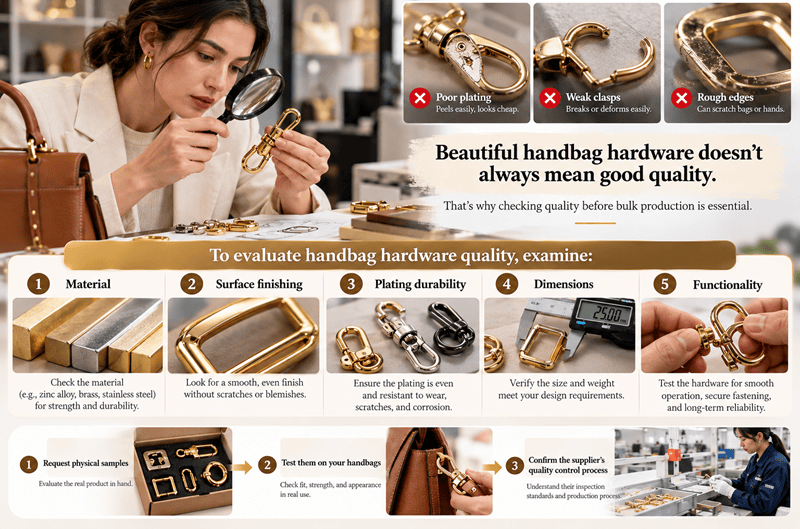
Beautiful handbag hardware doesn't always mean good quality. Poor plating, weak clasps, or rough edges can cause customer complaints. That's why checking quality before bulk production is essential.
To evaluate handbag hardware quality, examine the material, surface finishing, plating durability, dimensions, and functionality. Request physical samples, test them on your handbags, and confirm the supplier's quality control process.
1. Check the Material Quality
The material directly affects the hardware's strength, weight, appearance, and price.
Common handbag hardware materials include:
| Material | Advantages | Common Applications |
|---|---|---|
| Zinc Alloy | Cost-effective, easy to die-cast, excellent for complex designs | Logo plates, locks, decorative buckles |
| Brass | Durable, corrosion-resistant, premium appearance | High-end clasps, rings, decorative hardware |
| Stainless Steel | Strong, corrosion-resistant, long-lasting | Chains, rings, functional components |
| Aluminum | Lightweight, easy to anodize | Lightweight decorative hardware |
| Iron | Affordable, easy to stamp | Chains, basic rings, budget hardware |
In my experience, zinc alloy is one of the most practical choices for customized handbag hardware.
It can be die-cast into complex shapes, making it suitable for decorative locks, metal logo plates, and unique hardware designs.
However, the material alone doesn't determine quality. A well-manufactured zinc alloy component can outperform a poorly designed component made from a more expensive material.
I always recommend asking suppliers to specify the material grade rather than simply saying "high-quality metal."
2. Examine the Surface Finishing and Plating
Have you ever seen handbag hardware that looks beautiful when new but starts fading after a few months?
Poor electroplating is often responsible.
When evaluating samples, pay attention to:
- Surface smoothness: There should be no visible scratches, pits, or rough edges.
- Color consistency: Gold, silver, and gunmetal finishes should match across different components.
- Plating adhesion: The coating should not peel or flake during normal use.
- Polishing quality: Corners, edges, and recessed areas should be properly finished.
For handbags with multiple metal components, I strongly recommend requesting all hardware in the same plating color.
Otherwise, you might receive gold zipper pullers that look slightly different from your gold clasps.
You can also ask your supplier for corrosion-resistance test reports, such as salt spray testing, with agreed testing conditions and acceptance criteria.
3. Test the Hardware on Your Actual Handbag
A sample may look perfect on your desk but fail after installation.
For example, a swivel hook might look beautiful but become difficult to rotate once attached to a thick leather strap.
That's why I recommend installing samples on your actual handbag before approving production.
Check whether:
- Clasps open and close smoothly.
- D-rings and hooks can handle the intended load.
- Metal labels attach securely without damaging the leather.
- Zipper pullers move smoothly.
- All components fit the bag's design and dimensions.
For functional hardware, repeated opening-and-closing tests and suitable strength tests can reveal problems that visual inspection cannot.
4. Ask About Quality Control and After-Sales Service
A reliable supplier should have a clear inspection process.
At Trimixs, we pay particular attention to polishing, surface finishing, logo details, and final inspections.
Before shipment, we can provide inspection photos or videos so customers can review their finished hardware.
However, even a careful inspection cannot guarantee that every component will be perfect.
What matters is how the supplier responds when something goes wrong.
Before ordering, ask:
"If I receive defective hardware, how will you handle the problem?"
A responsible supplier should investigate the issue promptly and offer an appropriate solution rather than avoiding responsibility.
Can the Supplier Customize Hardware for Your Brand?
Standard handbag hardware may not fully reflect your brand's identity. If you want distinctive designs, you need a supplier who can turn your ideas into actual products.
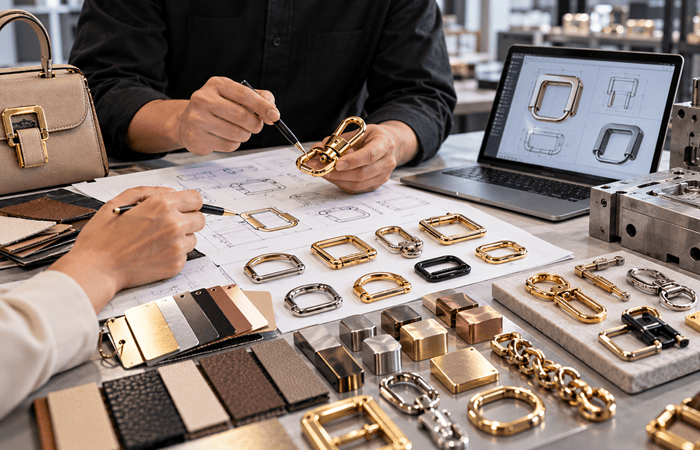
A reliable handbag hardware supplier should support custom logos, shapes, dimensions, materials, plating colors, and attachment methods. They should also offer mold development, sampling, and technical guidance before bulk production.
1. Ask for a Product Catalog First
If you're purchasing standard handbag hardware, my first suggestion is simple:
Ask your supplier for a product catalog.
Many suppliers already have hundreds of existing designs, including:
- Swivel hooks and snap hooks
- D-rings and O-rings
- Handbag locks and clasps
- Chains and strap adjusters
- Metal logo labels
- Zipper pullers
- Bag feet and decorative accessories
Choosing existing designs can save you considerable development time and tooling costs.
You may also find hardware that fits your brand perfectly without needing a completely new mold.
For emerging handbag brands, this is often the most economical way to start.
2. Check Whether They Can Develop Custom Molds
If you want something unique, ask whether the supplier can manufacture custom hardware based on your drawings or samples.
For example, you might want a metal handbag lock featuring your brand's initials or a custom-shaped metal logo plate.
A capable supplier should explain the entire development process.
Typically, it includes:
- Design submission: Provide your logo, technical drawing, or reference sample.
- Technical evaluation: Confirm dimensions, material, structure, and production feasibility.
- Quotation: Receive pricing for tooling, samples, and bulk production.
- Sample development: Review the first physical sample.
- Sample approval: Confirm the appearance, dimensions, and functionality.
- Mass production: Begin production based on the approved specifications.
At Trimixs, we support customized metal accessories, including metal logo plates, buckles, zipper pullers, and decorative handbag hardware.
3. Understand the Different Customization Methods
Not every custom design requires a new mold.
| Customization Method | Best For | New Mold Required? |
|---|---|---|
| Laser Engraving | Logos, initials, simple text | Usually no |
| Die Casting | Unique shapes, raised 3D logos | Usually yes |
| Stamping | Flat metal components, simple designs | Often |
| Electroplating | Gold, silver, gunmetal, rose gold | Usually no new shape mold |
| Enamel Filling | Colored logos and decorative details | Depends on the base design |
For small orders, laser engraving on existing hardware can be a cost-effective option.
For brands looking to develop exclusive designs, custom die casting offers greater flexibility.
4. Confirm MOQ and Mold Ownership
Minimum order quantity is especially important for new handbag brands.
Some factories require 1,000 pieces or more per design or plating color.
However, not every brand needs that quantity when launching a new collection.
I recommend asking whether the supplier supports smaller trial orders or allows multiple colors within one order.
Also, clarify who owns the mold after paying the tooling fee.
Can you reuse it for future orders? Can it be transferred to another manufacturer?
These details should be agreed upon before production begins.
Should You Work With a Manufacturer or a One-Stop Hardware Supplier?
Many buyers assume working directly with a factory is always cheaper and better. However, handbag production involves many different hardware components, and one factory rarely specializes in everything.
Choose a specialized manufacturer when you need large quantities of specific components. A reliable one-stop hardware supplier may be better when you need multiple product categories, flexible MOQs, consistent finishes, and simplified communication.
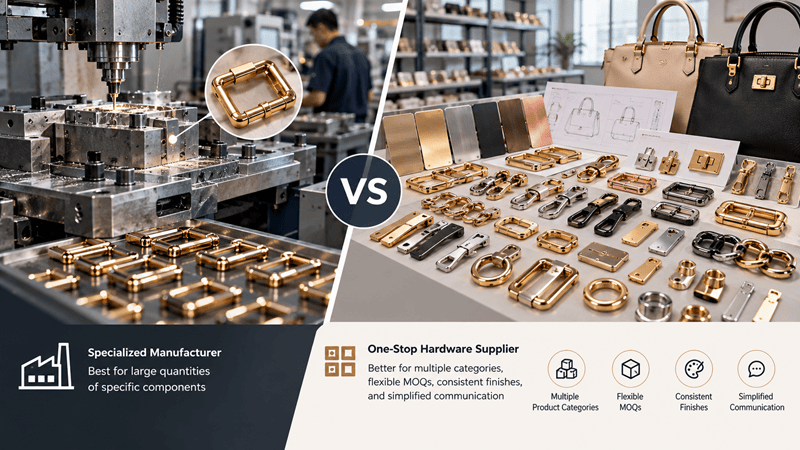
1. Advantages of Working Directly With a Manufacturer
If your handbag brand purchases thousands of identical locks or clasps, working with a specialized factory can be a good option.
Manufacturers often have better control over their particular production processes.
Their advantages may include:
- Competitive pricing for large-volume orders
- Specialized production equipment
- Direct technical communication
- Greater control over specific manufacturing processes
However, factories also have limitations.
A factory specializing in zinc alloy die casting may not manufacture stainless steel chains, woven labels, or zippers.
You might need several factories to complete one handbag collection.
That means more communication, separate shipments, and potentially inconsistent plating colors.
2. Advantages of a One-Stop Hardware Supplier
A one-stop supplier helps you purchase different components through a single contact.
For example, imagine you're launching a handbag collection that requires:
- 500 metal logo plates
- 500 handbag locks
- 1,000 swivel hooks
- 1,000 D-rings
- 500 zipper pullers
Instead of communicating with five different factories, you can coordinate everything through one supplier.
| Comparison | Specialized Manufacturer | One-Stop Hardware Supplier |
|---|---|---|
| Product Range | Usually focused | Multiple categories |
| MOQ | May be higher | Often more flexible |
| Communication | Multiple contacts if sourcing different products | One main contact |
| Pricing | Competitive for large volumes | Depends on sourcing arrangements |
| Customization | Strong in specialized products | Depends on manufacturing partners |
| Quality Control | Direct production oversight | Requires coordinated inspections |
| Shipping | Separate shipments possible | Consolidated shipping possible |
For small and medium-sized handbag brands, a reliable one-stop supplier can save considerable time.
However, I wouldn't choose a supplier simply because they offer many products.
The most important question is whether they can consistently control quality across different factories and production processes.
3. Start With a Small Trial Order
Before placing a large order with any new supplier, I strongly recommend starting with a small order.
This is one of the simplest ways to evaluate whether the supplier is genuinely reliable.
During the trial order, pay attention to three things.
First, product quality.
Does the finished hardware match the approved sample? Are the plating colors consistent? Are the dimensions correct?
Second, communication.
Does the supplier reply promptly, provide accurate quotations, and update you on production progress without repeated reminders?
Third, service and responsibility.
Does the supplier solve problems proactively? If something goes wrong, do they explain the situation and suggest a reasonable solution?
A supplier who handles a small order carefully is worth considering for a larger partnership, although repeat orders are still needed to establish long-term consistency.
4. Why Choose Trimixs as Your Handbag Hardware Supplier?
At Trimixs, we understand that handbag brands need more than just attractive metal accessories.
They need reliable quality, reasonable prices, flexible quantities, and efficient communication.
That's why we focus on the following services:
Reliable Manufacturing Partners
We work with trusted production partners and coordinate quality requirements and delivery schedules across different hardware categories.
Flexible Minimum Order Quantities
Some factories require large quantities for each design or color. We work to accommodate smaller orders when production conditions allow.
Efficient Communication
We aim to understand your requirements from the beginning, provide clear quotations, and reduce unnecessary back-and-forth emails.
Quality Inspection Before Shipment
We can provide inspection photos and videos so you can review your hardware before delivery.
Responsible After-Sales Support
If you encounter a quality issue after receiving your goods, we will help investigate it and work toward a suitable resolution.
For brands that need different types of handbag hardware, our goal is to make sourcing simpler and more dependable.
Conclusion
Choosing a reliable handbag hardware supplier requires careful quality checks, flexible customization, clear communication, and responsible service. Start small, evaluate performance, and build a dependable long-term partnership.

